The Prophet's followers
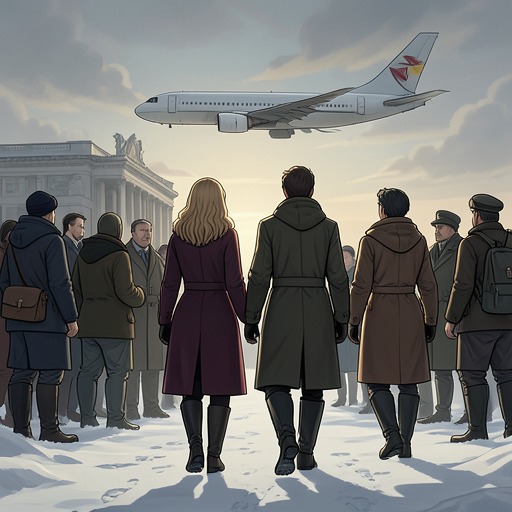
Station ElevenThe Prophet's followers are a sect of religious wanderers whose movement through the post-collapse world brings together communal life, prophetic belief, and armed coercion. Their leader’s claim that catastrophe has a divine purpose gives the group a language of shared destiny, while its takeover of St. Deborah by the Water reveals the force behind that language. Later, the Prophet’s pursuit of the Travelling Symphony ends in his death, but the narrative does not establish what becomes of the wider group.
Origins and Early Reception
The followers first appear in St. Deborah by the Water after the Travelling Symphony has left Charlie and Jeremy there. They are nineteen people who settle in the Lawn and Garden Department of a Walmart, making a communal encampment. They tell the townspeople they have come in peace. Although rumors about their travels through Virginia and farther south make some residents uneasy, the group initially seems friendly and self-sufficient: its members share meat from their hunts, help with chores, and mostly keep to themselves.
That quiet presence obscures both the hierarchy within the group and the leader’s authority. The tall blond man at its head is known only as the Prophet; when introduced, he presents himself as a messenger guided by visions and prophetic dreams. The townspeople have not been told his real name. His followers say he came from the Museum of Civilization and took to the road in childhood to spread his message of light. The distinction between what the Prophet claims and what his followers report matters: his authority is personal, but the group sustains it by carrying and affirming stories about his visions.
One such story describes the followers stopping their journey after the Prophet saw three ravens flying low across the road. The others did not see the birds, but accepted his insistence that they stop. The following morning they encountered a collapsed bridge and a riverside funeral for three people who had died when it fell. The followers treat the coincidence as evidence that his vision had saved them. Their belief thus grows not only from a teaching but from a remembered episode made meaningful after the danger has passed.
Doctrine and Collective Identity
At a performance by the Travelling Symphony, the Prophet addresses the assembled audience and presents the Georgia Flu as a divinely intended cleansing. He interprets the pandemic’s extraordinary mortality as evidence of purpose rather than chance, describing those who survived as chosen to carry and embody the light. In his account, the earlier pandemic was not the final catastrophe: he predicts further cullings and presents his dreams as advance knowledge of a divine plan. The sermon gives the followers a collective identity based on survival, purity, and a mission they are meant to carry into the future.
The doctrine also supplies a rationale for controlling membership. The Prophet tells the Symphony’s conductor that people who leave without permission are treated as dead: the group holds funerals and places markers for them. He frames departure as a death of the soul, not merely a change of residence. In this way, his authority reaches beyond those physically present. The rule makes remaining a matter of religious belonging and makes unauthorized exit legible to the community as an irreversible rupture.
The Prophet’s ideas are not confined to his own following. Later, Clark describes the belief that the pandemic happened for a reason, and Elizabeth agrees with the proposition that it did. That exchange does not establish her as a member of the sect; it does show that the Prophet’s explanation draws on a wider post-collapse search for meaning. His distinctive claim is to turn that search into a doctrine of election and a basis for his group’s authority.
From Encampment to Control
The turning point in St. Deborah by the Water comes when winter fever strikes and the mayor dies. The Prophet adds the mayor’s wife to his existing household of wives and moves with his followers into the gas station at the town’s center. Residents had not understood how much weaponry the newcomers possessed. Within a week, it is clear that the town is under the Prophet’s control. The contrast with their first days is stark: people who had shared food and helped with chores are now associated with an armed power that has displaced the town’s former leadership.
Reports from a plantation farther south show how the group’s reputation travels beyond the town. Edward recalls that about twenty followers arrived together, singing a hymn as they approached; by the time they reached the plantation, there appeared to be closer to fifteen. Their leader identified the group through its language of light. Edward had already heard from traders that the followers were armed, ruthless, and accustomed to taking what they wanted. The Prophet then offered to trade something the plantation community wanted for its guns and ammunition. The account establishes an exchange backed by the group’s reputation and weapons, though it does not disclose what the offered item was in the evidence presented here.
The Prophet’s followers are therefore not represented only as an itinerant religious community or only as a military threat. Their public hospitality, shared labor, and collective stories help explain why people may initially receive them; the later discovery of their weapons and their seizure of local power alters the meaning of that welcome. The evidence does not specify the roles or decisions of individual followers in these changes, so the group’s power is principally seen through the Prophet’s leadership and the effects of its presence on the communities it encounters.
Pursuit and the Group’s Unresolved Fate
The followers’ reach extends into the Prophet’s pursuit of the Travelling Symphony. Near the road to Severn City Airport, Kirsten hears him discuss the route with armed men. He identifies what he considers the only logical path and proposes splitting into two groups to cover alternate roads before meeting again at the airport road. The episode shows a capacity for coordinated pursuit: the Prophet interprets a map, anticipates the Symphony’s possible route, and directs armed companions accordingly.
The group’s religious language also governs how its members understand danger and restraint. When Sayid is held as a hostage, the Prophet calls the hostage’s presence a test and casts resistance to provocation as part of the followers’ task. He again describes the group as bearing the light. His words recast a practical danger as a trial of faith, allowing obedience and continued pursuit to appear as religious duties rather than merely strategic choices.
The pursuit ends when a boy accompanying the Prophet shoots him during a confrontation with Kirsten. August’s arrow brings down one armed man, and a second man is also killed as the confrontation unfolds. Kirsten and the boy are left together on the road before August and the Symphony’s scouts arrive. The episode ends the Prophet’s personal authority, but it does not say whether the surviving followers abandon the movement, continue it under another leader, or disperse. That silence leaves the organization’s future distinct from the definite end of its founder’s rule.